Showing posts with label Paris Automobile Exposition. Show all posts

Sunday, July 30, 2023

Did Women Make Manufacturers Paint Cars in Many Colors?

 It’s often been written that if not for women, car colors would only be selected for economy or colors identified with their corporate manufacturers. Without taking that notion for granted, it’s not something easy to prove or to disprove.

A well-researched and cited article by Jithin R. Veer published on a Virginia Commonwealth University site says that “The first cars were unpainted; if painted they were often painted dark gray or black. Black paint was used primarily because it was the least expensive. However, it is also likely black paint was used naturally because, during the gilded age, most machinery and objects of transportation, from carriages to steam railroads to iron-clad steamships were painted black.” I am sure that most of us can pick apart a lot of this statement. 

There is no reason for Veer to include it, as he later states, “From 1908 to 1914, Model T Fords were painted in a variety of 4 to 5 available colors. All colors of were of darker shades. Interestingly enough, black was not offered as a color initially. However, from 1914 to 1926, all Model T Fords were indeed painted black. The reason behind this color choice was purely economic: Ford wanted to produce the most number of automobiles in the least amount of time. Because black paint at the time was the least expensive and dried the fastest, black paint allowed Ford to produce a car in about 90 minutes.” Veer’s concludes that “the evolution of color in the American automobile (industry) in the last century has been determined by economic issues facing the automaker, the national mood reflected in consumers, and the consumers’ tastes.”

In order to determine whether “economic issues” include “competition”, whether “consumers” include “women” and “consumers’ tastes” include “colors appealing to women,” let’s expand the story’s scope and include the view of females in society as to the interaction they’ve had with the automotive industry.

The first automobile company founded by a woman was the Twentieth Century Motor Car Corporation started by Geraldine Elizabeth "Liz" Carmichael, in 1974. The company's flagship vehicle was the Dale, a prototype three-wheeled two-seater automobile designed and built by Dale Clifft. The company would ultimately prove to be fraudulent when Carmichael went into hiding with investors' money rather than build the 50,000 first year models as advertised.


The first female CEO of one of the big three auto makers is Mary Barra of General Motors, a long-time employee of the company rising from inspecting fender panels at 18 to CEO in January 2014 succeeding five other CEOs in six years as the company entered and exited bankruptcy. She has a BS from Kettering University in electrical engineering and an MBA from Stanford.

Jan Bertsch was vice president of sales and marketing at Chrysler for a short time after 2005 having worked at many lower positions at both Ford and Chrysler, and Jill Lajdziak was the VP of Sales, Services, and Marketing at GM’s, Saturn division back in 2000.  I can find neither listed as the first female vice president of sales, so there might have been someone earlier, perhaps even much earlier, but certainly no one in the 1920s or 30s.

The first female automotive designer, Helen Rother, was the subject of an article in our March, 2023 issue. Reminder, she worked for GM as an interior designer beginning in 1943.

In a 2010 article, Forbes said that 95% of car dealers were men. It’s often quoted that car salesmen are patronizing to female buyers figuring that their priority would be the car’s color above price or performance, A 2016 Groove auto study said that in a survey a woman’s favorite car color was gold or beige, and a 2017 iseecars.com survey said that a woman’s favorite car color was teal. Surveys have been taken, but female car salesmen have not been hired possibly leading to bias in both surveys and interactions with female purchasers.

Clearly during the Model A Era, women were not automotive producers.  Evidence does, however, say that they were consumers. A 1914 Saturday Evening Post marketing report said: “Whatever is bought for family use is selected largely by the wife, and the automobile is no exception. Dealers’ estimates of the proportion of sales of pleasure cars in which women are an important factor vary from 50 percent to 95 percent.” In a 2019 MSNBC story, 65% of new car purchases were made by women.

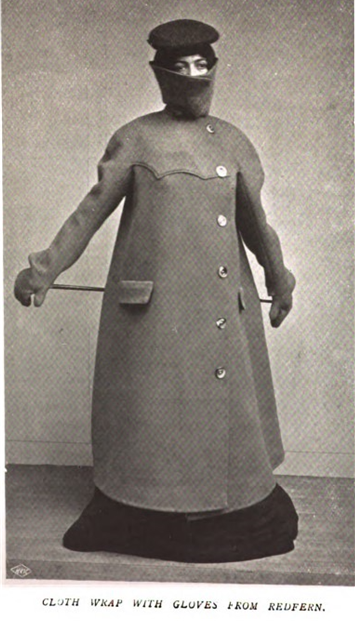
As with any new invention, the consumer generally adapts before that market adapts to the consumer. Nicole Moelders, the author of the High Latitude Style Blog, makes the point that very early on in automotive history, female passengers struggled to find appropriate dress.  Big, fluffy hats, corsets bustles and high boots which could be quite comfortable in a street car would be poor choices for style or comfort in a small, opened, runabout – and over 70% of cars sold up to the early teens were open. Women’s adaptations included wearing scarves to tie down smaller hats without feathers or flowers, motor coats to cover shorter dresses without trains and without gold wire and gemstones that could catch, and even goggles. Included is an illustration from the January 25th 1902 issue of Country Life magazine.


Dorothy Levitt, pioneering British auto racer, in 1909 spoke to women who expected to be not only passengers, but possibly also drivers.  They would still need to protect their fashionable clothing, but with something more like a duster than a motor coat, but they’d also need to operate the pedals and nimbly hop into the driver’s seat after cranking the engine, so they would need an even shorter skirt and not wear high lace up boots. They would want gloves, not just to keep their hands warm, but so as their hands wouldn’t smell of gasoline when they took them off.
Fast forward to World War One during which women not employed as domestics or farm labor – which the Bureau of Labor Statistics didn’t count – rose from 23.6% of the labor force to 46.7% in 1918.  Flappers had the reputation, even with historians, as women who smoked, drank, listened to jazz, were openly sexual, and generally flaunted their disdain for what was then considered acceptable behavior.

From this historian’s perspective, knowing from my parents that teens in the Fifties were nothing like Grease and little like Happy Days; knowing from a 1970 Kent State student, that the few students shot were hopeful academicians wanting to limit campus recruitment during Viet Nam instead of hundreds of drug-fueled hippies taking over the campus who sought martyrdom. So, this image of 1920’s young, irresponsible feminism, should be looked at with skepticism. Statistically, there was a  baby-boomlet in 1919, but the fertility rate and the number of babies born out of wedlock actually declined during the twenties. Politically, at the time women pushed for prohibition equally with suffrage. So, it’s no great leap to actually admire so-called flappers for taking jobs, getting an education, and wanting to wear practical clothing while they drove themselves to work or to college.  They were adapting to the needs of their time, including driving automobiles.
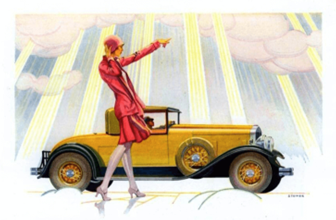

In a 1929 newspaper article, record-setting pilot, Louise McPhetridge Thaden explained that women, in jobs like publicity, sales work, and design, especially design, will make their influence felt. "If you remember the bare, uncomfortable, inconvenient automobiles of a few years ago? Well, compare them with this'', with a gesture she indicated the luxurious interior of the Graham-Paige car besides which she was standing. "Do you see the difference? Women brought that about. Upholstery, engine starters, easy gear shifts, color, beauty, ease of handling, convenience. Those are women's work. Automobiles now are nicer than parlors used to be.”

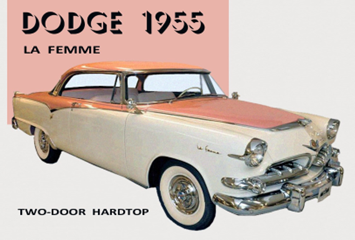
I couldn’t find any new features meant to appeal to women introduced in the 1930s and 40s, in fact quirky items like bud vases disappeared. In 1955 Dodge introduced the Le Femme, a car that came with a matching purse, raincoat and umbrella. It had a pink interior with rose-patterned trim. It was a trim option available on Dodge Custom Royal Lancer models, but was unpopular and fewer than 2500 La Femmes were sold. 

Lastly, women haven’t gone away.  They remain major purchasers of cars and therefore an influence of car design.  If they were what caused cars to be painted in a greater variety of colors in the 1920s, manufacturers would continue to use a variety of colors today (or conspire together to only provide boring, colorless options that depress purchasers who feel they have no choice.)  According to iseecars.com (that said that women prefer teal) 78.6% of all cars sold today are shades between white and black, 9.5% are blue (either a silvery, metallic sky-blue [see silver with blue] or a very dark metallic blue [see gunmetal grey with blue], and 8.6% are red. Really noticeable colors like orange, purple, gold and yellow make up a combined 1% of cars produced.


In an unscientific study, I searched craigslist for the new beetle as it struck me as being the only models with routinely bright colors – my sons even pointing them out as “girl cars” which they would never own.  There were 13 available for sale, of which two were red, one yellow, and one metallic bronze. The other 9 were shades from white to black plus blueish greys.  Above is an advertising photo of 2023 Ford models which show a wide range of colors. It seems that image and reality diverge; what’s desired and what’s produced. Sorry, women.


Hat Boxes?


Frances Paget mentioned that lady designers were adding hat boxes to fashionable cars at the Paris Automobile Exhibition of 1928, but was that a thing?

Indeed inventors were still coming up with new designs for hat boxes in the Model A era, but separate from auto accessories—just the box. Traveling bags were still new inventions. The first “case for suits” or suitcase I could find was in 1890. (The story also included a walking stick case, a boot case, and two shirt cases.) In 1912 I found the earliest example of a hat box meant for a car.  It, along with everything else meant for travel, was planned to be attached outside of the passenger’s compartment. See the photo.

In a description of a rally in 1916, there was a long list of all of the packages dropped by the many cars along the way because the roads were in such poor condition. Lost tools and spare parts were packed in several hat boxes because drivers realized that they were ideal for holding many things besides hats.


Amazingly, there aren’t many advances over the next decade. I see an advertisement in 1920 that perhaps is a metallic hat box that, once it is attached to your running board, can be painted your car’s color, or you can leave it black.

In 1924, Studebaker Big Six models, had hat boxes standard in the back on the trunk rack  (also such conveniences as a rear view mirror, a flower vase, and an automatic gasoline signal.)

In 1925 I find the first hint of what we know as a “glove compartment”, but I want to know how the illustration matches the dimensions described in the text. How are all of these muffin pans going to  fit into a 4” by 6 “ opening? In the same article, they advise obtaining a light wire basket and sewing it through the car’s headliner with the thread holding firmly onto the chicken wire as a place to store hats that won’t be sat upon.

In 1928, hat boxes and glove compartments inside of automobiles would have been a minor sensation, although, not enough to make immediate changes in U.S. automotive design.

The earliest example of a dash compartment built into an American car is in the REO Royal 8 for 1931—not for any of their other models. In 1933 Plymouth added a dash compartment for several of their models.  In 1934, Ford & Chevy added dosh boxes as well.

Wikipedia credits Packard with the first glove box way back in 1900, and Dorothy Levitt, pioneering British auto racer, with inventing the term in 1909.  These are both true, and not true at the same time, as the 1900 Packard had the engine behind the driver, and nothing in front, picture an VW beetle—would you call that a glove compartment or a trunk? Why didn’t they put a door inside the passenger compartment or continue it after their cars moved the engines to the front?


And Dorothy Levitt did suggest having a box inside your car to hold your driving gloves in her 1909 book
The Woman and the Car. That way oil and grease wouldn’t stain the upholstery and get on your clothes. Not to dispute the soundness of that advice for the time, but her advice was for a box, in the car, she didn’t advise cutting a hole in the dash, and installing a box there like The American Blacksmith, etc. in 1925.

I would also say that door pockets and cubbies under seats, used to store gloves, that predate 1931, also don’t count as glove compartments.


Thursday, July 27, 2023

Helen Rother - First Female GM Designer

Helene Rother (1908–1999) was (according to Wikipedia) the first woman to work as an (American) automotive designer.  Although far from it, she was the first recognized by the Automotive Hall of Fame for "her influence on the styling and design of vehicle interiors.” Rother was trained at the School of Applied Arts in Hamburg and later at the Bauhaus School. In 1932, Rother gave birth to her daughter and lifelong companion, Ina Rother. The father, Erwin Ackerknecht, who would later be active in the French Resistance and apart from her for years while on the run, moved them to Paris in 1933.  For an income, Helen created popular jewelry shaped like animals. She fled the Nazi occupied France in 1940 when she and her daughter squeezed into a mail truck with six other people, along with eight show cats, a Siamese cat, and a couple canaries. No one was going to chance leaving their prize pets to the Nazis. They were first evacuated to a refugee camp in Casa Blanca, then in 1941 to New York City where she was an illustrator for Marvel Comics.

After two years there, she moved to Detroit to work for General Motors. She joined the interior styling staff and was responsible for upholstery colors and fabrics, lighting, door hardware, and seat construction.

In 1947 she established her own design consulting business and was soon contracted by Nash Motors and styled the elegant interiors of most of the cars from 1948 to 1956. In 1948 she published a technical paper with the Society of Automotive Engineers (SAE) asking "Are we doing a good job in our car interiors?"  Her presentation at the annual conference marked the first time that a woman addressed the SAE.

In 1953 she bought a 200-acre farm in far-off Metamora and made the 96 mile round trip commute to Detroit for work.


"Designing Women"


I first mentioned the prolific inventor Margaret E. Knight (1838-1914) in the August 2019 issue page 8. Era Grocery Shopping, because in 1868 she invented a machine to fold and glue paper bags. Much later, she established a workshop in Brookline, Massachusetts in hopes of developing a sleeve-valve engine. Between 1902 and 1904 she patented a number of improvements to sleeve valve engines and in 1903 was issued a patent for an automatic boring tool for boring or planing concave or cylindrical surfaces. 

Her timing was too soon, though, and she was unable to get financial support for nearly a decade, and only then from a relative, Anne F. Davidson. They formed the Knight-Davidson, or K-D Motor Co. (Anne’s daughter Beatrice called her “Aunt Maggie” and Anne’s maiden name was indeed Knight, but Anne’s father was George and Margaret’s was James. I was unable to follow either family farther back, and they were born in distant states from the other.)

In 1913 Moore & Munger manufactured a Charles R. Greuter-designed phaeton body for the Knight-Davidson prototype. Knight displayed the finished vehicle at that fall’s Boston Automobile Show hoping to license her sleeve-valve engine to an established automobile manufacturer.     Beatrice reported that several prototypes were ordered at a $6000 price.

Unfortunately Knight died before any licensing agreements and no further Moore & Munger vehicles are known to have been constructed with her engine. Of note, Margaret was unrelated to Charles Knight, the inventor of a sleeve-valve engine that did go on to series production as part of the Willies-Knight company. 

Florence Lawrence, a silent film star, later became the president of her mother’s company, Bridgwood Manufacturing, a producer of after-market automobile features. Both mother and daughter were also brilliant inventors. Her mother invented a patent for a type of windshield wiper in 1917, while Lawrence invented the first car turn signal, or “auto-signaling arm,” and the brake signal for automobiles. However, Lawrence did not patent her inventions and did not receive any profits from licensing her work, just manufacturing them.

Marie Luhring made history by becoming the first female truck    designer and distinguishing herself as one of the top designers in the country when she was hired in 1920 by Mack Truck.

Unfortunately, none of these women survived into the Forties when several American women were hired as designers by major automobile manufacturers.


1928 Paris Auto Show


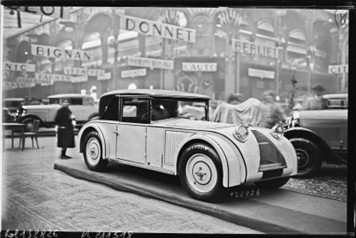
The Salon de l'Automobile is a biennial auto show in Paris. Held during October annually for a century, and then in even years for the last quarter century (Munich & Tokyo are the locations for odd years). It is the oldest, founded in 1898 and the most attended auto show in the world. It is important because of the debuts of new production automobiles and concept cars. The show was organized by Chambre Syndicale de l'Automobile at the time, but now is run by an association of international auto manufacturers.

For the 1928 show, 80 French automakers had displays compared to only 26 from America. It remains mostly French, but with fewer and fewer manufacturers in the world, individual manufacturers now have larger displays. 

I had wanted to write a unique article on the women involved with this particular salon, but although I have access to dozens of articles on the 1928 edition, I do not have access to the Bulletin Officiel de la 22e Chambre Syndicale Nationale l'Automobile Salon which would possibly provide me the info. (in French). Paget’s is the only one mentioning women.

The articles I found were often by representatives of American manufacturers saying nothing about the show except that their company was the best poised for a major sales increase in 1929.  I also found articles on cars with yellow chrome, colorful roofs, fenders, and brake drums. There were articles detailing the color schemes of many cabriolet limousines the French companies displayed, and articles on mechanical advances like four-wheel brakes & independent front suspension.


Women Were Big Consumers of Automobiles


Within the October 24, 1928 issue of The Madera Tribune there is an article titled “Fashion Wave has Hit Auto”.

This single article introduces way more than I should put into a single issue.  I plan to spread out my ideas through a short series, each issue covering several ideas and what I’ve found to back them up.  I’ll start with the article itself:

 FASHION WAVE HAS HIT AUTO

By FRANCES PAGET Copyright, 1928, by Women's Wear Magazine '

NEW YORK. Oct. 23. — (United Press) — Women's influence was marked and commented on freely by the International press when the Paris Automobile Exposition opened its doors. Indeed many of the cars were decorated by women artists, and all attested to the influence of women and fashion.


New baggage contrivances, such as hat boxes and coat hangers, were introduced, and such materials as tapestry and leopard skin were reported as effectively used for madame's sedan. What a change from the early days of the automobile, when practically everything about It. and certainly its linen dusters, and goggles and helmets and veils were unsightly.

A woman, be she driver or passenger, is no longer handicapped in her choice of effective motoring garb. She Is inclined to go to the length of preserving harmony in the coloring of her car and her costumes. The feminization of fashion, which for a while was swayed by masculine Influences Is commented on further in Paris reports whether women are becoming more feminine, whatever that may mean, or whether the upper classes are again leisure classes, the Haute Couture has paid increased attention to negligees for the last year or so, and one can find in Paris a great variety of type design with a slight leaning toward modernistic effects. The entire feeling in the mode today is for apparel appropriate to the occasion, and expressive of not only of one’s individuality, but of one’s endeavor.

I hope to answer who was Frances Paget? What was Women’s Wear Magazine? What was the Paris Automobile Exposition? Who were some of the women artists who decorated the displayed cars and how were they unusual?

What was a car’s hat box and a coat hanger? How have car interiors changed over the years? How did ladies dress in the early days of cars?

What’s the history of women dressing in shades that harmonize with their cars? Did women at an earlier time dress more to attract men than to look like a woman or to be comfortable? Did the Jazz Age—when the upper classes let loose and partied — wait until October 1928 to debut in  Paris? What special improvements to a woman’s nighties were made in 1927? Did dressing for your endeavor gain a certain flair in the late twenties?

Throughout this series, I’ll let you know roadblocks I encounter and hope to lend you an idea of what the readers of that article might have understood that it was trying to tell them and what, if anything, might have been influenced to change by the 1928 Paris Automobile Exposition.


Ben Preston and his Death Car Roadster

From The Whittier Daily News, Thursday, July 9, 1936:   WICHITA, Kans.—Ben Preston, mechanic, probably owns the world’s most gruesome autom...