Sunday, July 30, 2023

Hat Boxes?


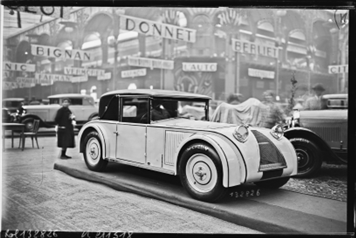
Frances Paget mentioned that lady designers were adding hat boxes to fashionable cars at the Paris Automobile Exhibition of 1928, but was that a thing?

Indeed inventors were still coming up with new designs for hat boxes in the Model A era, but separate from auto accessories—just the box. Traveling bags were still new inventions. The first “case for suits” or suitcase I could find was in 1890. (The story also included a walking stick case, a boot case, and two shirt cases.) In 1912 I found the earliest example of a hat box meant for a car.  It, along with everything else meant for travel, was planned to be attached outside of the passenger’s compartment. See the photo.

In a description of a rally in 1916, there was a long list of all of the packages dropped by the many cars along the way because the roads were in such poor condition. Lost tools and spare parts were packed in several hat boxes because drivers realized that they were ideal for holding many things besides hats.


Amazingly, there aren’t many advances over the next decade. I see an advertisement in 1920 that perhaps is a metallic hat box that, once it is attached to your running board, can be painted your car’s color, or you can leave it black.

In 1924, Studebaker Big Six models, had hat boxes standard in the back on the trunk rack  (also such conveniences as a rear view mirror, a flower vase, and an automatic gasoline signal.)

In 1925 I find the first hint of what we know as a “glove compartment”, but I want to know how the illustration matches the dimensions described in the text. How are all of these muffin pans going to  fit into a 4” by 6 “ opening? In the same article, they advise obtaining a light wire basket and sewing it through the car’s headliner with the thread holding firmly onto the chicken wire as a place to store hats that won’t be sat upon.

In 1928, hat boxes and glove compartments inside of automobiles would have been a minor sensation, although, not enough to make immediate changes in U.S. automotive design.

The earliest example of a dash compartment built into an American car is in the REO Royal 8 for 1931—not for any of their other models. In 1933 Plymouth added a dash compartment for several of their models.  In 1934, Ford & Chevy added dosh boxes as well.

Wikipedia credits Packard with the first glove box way back in 1900, and Dorothy Levitt, pioneering British auto racer, with inventing the term in 1909.  These are both true, and not true at the same time, as the 1900 Packard had the engine behind the driver, and nothing in front, picture an VW beetle—would you call that a glove compartment or a trunk? Why didn’t they put a door inside the passenger compartment or continue it after their cars moved the engines to the front?


And Dorothy Levitt did suggest having a box inside your car to hold your driving gloves in her 1909 book
The Woman and the Car. That way oil and grease wouldn’t stain the upholstery and get on your clothes. Not to dispute the soundness of that advice for the time, but her advice was for a box, in the car, she didn’t advise cutting a hole in the dash, and installing a box there like The American Blacksmith, etc. in 1925.

I would also say that door pockets and cubbies under seats, used to store gloves, that predate 1931, also don’t count as glove compartments.


Zaza Frazee and Other Circus Folk


Marjorie Sylvester Frazee was the only daughter born to a well to do hop farmer in Santa Rosa, California,  Born March 13, 1905, She was married to 24-year-old Charles Quincy Adams at the tender age of 17.

After her marriage, though, things began changing and the couple soon separated, returning to their parents.

There are not a great number of great research items on circus performers, and being “show business” many of the records that do exist are untrustworthy.  In a 1936 article, in her home town newspaper, it says that at that time, she had been performing as a bearded lady across the country for many years already, as Mademoiselle Zaza Frazee.  I can find proof of neither assertion. I can only find her appearing in California from 1936 to 1942. 

In 1942 Marjorie moved back into her parents home and took over her parent’s business affairs, advertising for hops pickers and renting her family’s large home as a sanitarium or convalescent home.

Marjorie died March, 25 1962 after a long illness.

Other Frazee circus performers of the Model A era include aerialist and singer—Mademoiselle Frazee of Columbus, Ohio; Circus manager, Al G. Frazee of the Kit Carson Buffalo Ranch Wild West Show, and Al G Frazee, Jr. motorcycle stuntman for the Al G Barnes Circus. Honorable mention was Frank Eugene Eliason, a famous magician, who went by Frank Frazee.


Thursday, July 27, 2023

Helen Rother - First Female GM Designer

Helene Rother (1908–1999) was (according to Wikipedia) the first woman to work as an (American) automotive designer.  Although far from it, she was the first recognized by the Automotive Hall of Fame for "her influence on the styling and design of vehicle interiors.” Rother was trained at the School of Applied Arts in Hamburg and later at the Bauhaus School. In 1932, Rother gave birth to her daughter and lifelong companion, Ina Rother. The father, Erwin Ackerknecht, who would later be active in the French Resistance and apart from her for years while on the run, moved them to Paris in 1933.  For an income, Helen created popular jewelry shaped like animals. She fled the Nazi occupied France in 1940 when she and her daughter squeezed into a mail truck with six other people, along with eight show cats, a Siamese cat, and a couple canaries. No one was going to chance leaving their prize pets to the Nazis. They were first evacuated to a refugee camp in Casa Blanca, then in 1941 to New York City where she was an illustrator for Marvel Comics.

After two years there, she moved to Detroit to work for General Motors. She joined the interior styling staff and was responsible for upholstery colors and fabrics, lighting, door hardware, and seat construction.

In 1947 she established her own design consulting business and was soon contracted by Nash Motors and styled the elegant interiors of most of the cars from 1948 to 1956. In 1948 she published a technical paper with the Society of Automotive Engineers (SAE) asking "Are we doing a good job in our car interiors?"  Her presentation at the annual conference marked the first time that a woman addressed the SAE.

In 1953 she bought a 200-acre farm in far-off Metamora and made the 96 mile round trip commute to Detroit for work.


Betty Stonebraker


On June 27, 1928, Betty Stonebreaker (Stonebraker) was invited by Dr. & Mrs. T. P. Melbourne of 422 South Nevada for a game of bridge with their friend, Dr. R. W. Blodgett. Betty was recently transferred from the Riverside Pacific Telephone office to that in Oceanside.

Oceansiders might be familiar with dentist Melbourne and optometrist Blodgett.  The intension of the night seems pretty clear with 20/20 hindsight.  Thomas Melbourne had married Helen Plausse just three months before and Stonebraker and Blodgett were both single.

The 1930 Census, though, seemed to show the night as unsuccessful as it has Betty unemployed, back with her parents and Ralph Blodgett living in a bachelor pad with another dentist.

I was somewhat surprised then, that five years later, R.W. and Betty are married.

After some research I found that Dr. Blodgett grew up in Riverside, where Betty’s father, Perry Stonebraker was a “Stable Handler” at the local fertilizer plant, but had six daughters. Their homes were a half mile apart and Ralph certainly attended school with Betty’s older sister, Lucy.  So, the Melbournes were not the ones to introduce the two. They’d met growing up.

During the intervening five years, the two meet up again several times as covered in the newspapers back in the day. I can’t however, find their wedding announcement for January 1, 1933. 

The couple had two daughters, Sharon & Sandra Blodgett.  Sharon, doesn’t seem to have married, and she died in a car accident in Ramona in 2016.  Sandra married marine 2nd Lt. Robert B. Johnston, an English major she met at SDSU. Johnston is eventually promoted to Lt. General in the Marine Corps, and he served as Chief of Staff to General Norman Schwarzkopf in Desert Storm. The couple have retired to Tucson.


"Designing Women"


I first mentioned the prolific inventor Margaret E. Knight (1838-1914) in the August 2019 issue page 8. Era Grocery Shopping, because in 1868 she invented a machine to fold and glue paper bags. Much later, she established a workshop in Brookline, Massachusetts in hopes of developing a sleeve-valve engine. Between 1902 and 1904 she patented a number of improvements to sleeve valve engines and in 1903 was issued a patent for an automatic boring tool for boring or planing concave or cylindrical surfaces. 

Her timing was too soon, though, and she was unable to get financial support for nearly a decade, and only then from a relative, Anne F. Davidson. They formed the Knight-Davidson, or K-D Motor Co. (Anne’s daughter Beatrice called her “Aunt Maggie” and Anne’s maiden name was indeed Knight, but Anne’s father was George and Margaret’s was James. I was unable to follow either family farther back, and they were born in distant states from the other.)

In 1913 Moore & Munger manufactured a Charles R. Greuter-designed phaeton body for the Knight-Davidson prototype. Knight displayed the finished vehicle at that fall’s Boston Automobile Show hoping to license her sleeve-valve engine to an established automobile manufacturer.     Beatrice reported that several prototypes were ordered at a $6000 price.

Unfortunately Knight died before any licensing agreements and no further Moore & Munger vehicles are known to have been constructed with her engine. Of note, Margaret was unrelated to Charles Knight, the inventor of a sleeve-valve engine that did go on to series production as part of the Willies-Knight company. 

Florence Lawrence, a silent film star, later became the president of her mother’s company, Bridgwood Manufacturing, a producer of after-market automobile features. Both mother and daughter were also brilliant inventors. Her mother invented a patent for a type of windshield wiper in 1917, while Lawrence invented the first car turn signal, or “auto-signaling arm,” and the brake signal for automobiles. However, Lawrence did not patent her inventions and did not receive any profits from licensing her work, just manufacturing them.

Marie Luhring made history by becoming the first female truck    designer and distinguishing herself as one of the top designers in the country when she was hired in 1920 by Mack Truck.

Unfortunately, none of these women survived into the Forties when several American women were hired as designers by major automobile manufacturers.


1928 Paris Auto Show


The Salon de l'Automobile is a biennial auto show in Paris. Held during October annually for a century, and then in even years for the last quarter century (Munich & Tokyo are the locations for odd years). It is the oldest, founded in 1898 and the most attended auto show in the world. It is important because of the debuts of new production automobiles and concept cars. The show was organized by Chambre Syndicale de l'Automobile at the time, but now is run by an association of international auto manufacturers.

For the 1928 show, 80 French automakers had displays compared to only 26 from America. It remains mostly French, but with fewer and fewer manufacturers in the world, individual manufacturers now have larger displays. 

I had wanted to write a unique article on the women involved with this particular salon, but although I have access to dozens of articles on the 1928 edition, I do not have access to the Bulletin Officiel de la 22e Chambre Syndicale Nationale l'Automobile Salon which would possibly provide me the info. (in French). Paget’s is the only one mentioning women.

The articles I found were often by representatives of American manufacturers saying nothing about the show except that their company was the best poised for a major sales increase in 1929.  I also found articles on cars with yellow chrome, colorful roofs, fenders, and brake drums. There were articles detailing the color schemes of many cabriolet limousines the French companies displayed, and articles on mechanical advances like four-wheel brakes & independent front suspension.


Women's Wear Magazine


The lineage of Women’s Wear Magazine – now WWD, has both an oft copied mythical background and a true back story. Mythically, E. W. Fairchild bought a press rag from success selling soap, and single-handedly turned it into an international leader in women’s fashion overnight, his seeing a huge void in the market.

The true story begins with John B. Waldo, son of a successful lumber merchant, who began working as a grocery clerk in his teens. He was hired by Howard, White, Crowell & Co. in 1885 for the Chicago Commercial Bulletin and soon he was editing the publication. In 1890 Waldo founded the Chicago Apparel Gazette with funding by stock broker, Edmund Wade Fairchild, whose younger brothers operated a successful soap business.  On March 29, 1892 Fairchild used his own money this time to join Waldo to found the Waldo-Fairchild company, operating the Chicago Apparel Gazette, and to directly compete with Howard, White and Crowell by starting the Daily Trade Record with plans to distribute it at the Chicago World’s Fair in 1893. Its success was truly in covering the men’s apparel industry, though. 

I don’t have access to preserved copies of both newspapers, (Even the Chicago Public Library doesn’t have preserved copies) so I don’t know that they did use the same writers/stories for both papers, but it seems likely. They both were known by varying names throughout their lives, including the Daily News Record, later shortened to just DNR (to de-emphasize that the once daily publication had been decreased to just three times a week and then eventually once a week). The headquarters of Waldo-Fairchild moved to Manhattan, near the garment district and Madison Ave. in 1901.  The Chicago Apparel Gazette continued publication in Chicago and the company found two additional fashion magazines, Men’s Wear and Hat Life. In 1910, Women’s Wear Magazine began as a once-a-week page in DNR, was spun off as a standalone in 1919, and later became a daily. 

Eventually, the Chicago Apparel Gazette became Men’s Wear- Chicago Apparel Gazette edition continuing at least until WWII. In 1983, Men’s Wear, was shortened to M.  Women’s Wear Daily was shortened to WWD – not W. W, also a fashion magazine, once published by Fairchild, was founded separately, in 1972; Wikipedia highlights W’s oversized format as a difference between the two magazines.

Importantly for the life of the myth, Fairchild bought out Waldo entirely in 1903 and his son and grandson were the publishers until the company’s merger with, yes, The Disney Company in 1997.  Disney is not the only local tie to the story, however. The Fairchilds working as stock brokers included Edmund’s nephew Allan N Fairchild, and Allan is buried in the San Marcos Cemetery.


Ben Preston and his Death Car Roadster

From The Whittier Daily News, Thursday, July 9, 1936:   WICHITA, Kans.—Ben Preston, mechanic, probably owns the world’s most gruesome autom...